Walk into most Indian agricultural machinery trade shows and you'll hear the same claim from disc blade suppliers: "our blades are heat treated to high hardness." What you won't hear is the grade of steel they're starting with — because most of them are starting with high-carbon steel like 65Mn or 70Mn spring steel, and hoping the heat treatment makes up the difference.
It doesn't. The steel grade you start with determines the ceiling of what's achievable. Heat treatment is not a correction for mediocre steel — it's a multiplier. And when you multiply heat treatment against 28MnCrB5 chromium-boron steel versus high-carbon spring steel, you get a meaningfully different product.
What is 28MnCrB5?
28MnCrB5 is a boron-bearing manganese-chromium alloy steel. The name encodes its composition: 28 is the approximate carbon content (0.28%), Mn is manganese, Cr is chromium, B is boron, and 5 is the chromium multiplier. It's classified as a structural steel with high hardenability — meaning it can be hardened deeply and uniformly through the full thickness of the disc, not just at the surface.
The key addition is boron — typically around 0.001–0.005% by weight. That sounds like a trace amount, and it is. But boron has a disproportionate effect on hardenability. It segregates to austenite grain boundaries during heating and delays the formation of ferrite during quenching. The result: more of the steel transforms to martensite — the hard microstructure you're trying to achieve — and it does so at a lower cooling rate.
The chemistry in plain terms
When you heat steel above its critical temperature and then quench it, you're trying to "lock in" a hard microstructure called martensite. The faster you can cool the steel, and the more uniformly you can do it, the more martensite forms. High-carbon steels need very aggressive quenching to achieve this — which introduces thermal stress, distortion, and cracking risk. Boron steel achieves the same result with a gentler quench, which is why it pairs so well with press quenching: the die constrains the disc during cooling, controlling both hardness and geometry simultaneously.
"Boron steel achieves the same hardness as high-carbon steel with a gentler quench — which is exactly why it pairs with press quenching to control both hardness and geometry at the same time."
The numbers: 28MnCrB5 vs 65Mn side by side
| Property | 28MnCrB5 (our grade) | 65Mn spring steel (common alternative) |
|---|---|---|
| Carbon content | 0.28% | 0.65% |
| Achievable hardness | 48–52 HRC (full cross-section) | 42–48 HRC (surface-biased) |
| Impact toughness | High — ductile failure mode | Lower — brittle fracture risk under shock load |
| Hardenability depth | Full section — uniform through 6mm+ | Decreases toward centre at 5mm+ |
| Distortion on quench | Low — compatible with press quench | Higher — typically requires post-quench straightening |
| Edge retention | Superior — hard edge maintained longer | Good initially, degrades faster |
| Weld/repair suitability | Better — lower carbon equivalent | Difficult — high carbon causes HAZ cracking |
Why impact toughness matters more than peak hardness
A disc blade doesn't work in a laboratory. It works in a field with stones, buried debris, old tractor parts, and dry hard-pan that can spike load far beyond what the disc was designed to handle during normal tilling. In those moments, the question isn't "how hard is the disc?" — it's "how does the disc fail?"
High-carbon steel fails brittly. When it hits a stone at the wrong angle, it shatters or cracks. Boron steel fails ductilely — it deforms rather than fractures, which means a bent disc rather than a broken one. A bent disc might slow you down for a few hours. A shattered disc can damage the frame, bearings, and adjacent components — and you won't find what you need to replace them in the nearest town.
In hard or stony conditions, the mode of failure matters as much as the hardness rating. 28MnCrB5 deforms under extreme shock load rather than fracturing — which is the failure mode you want in a field 50km from a dealership.
Why most Indian manufacturers still use high-carbon steel
The honest answer is cost and availability. High-carbon spring steel like 65Mn is cheaper, easier to source domestically, and requires less process discipline to heat treat. When buyers are primarily comparing price per piece rather than cost per season, the incentive to invest in better steel is limited.
The second reason is that hardness is invisible until you measure it — and most buyers don't. A blade that tests at 42 HRC looks identical to one that tests at 50 HRC. You only find out the difference when one lasts two seasons and the other barely makes it through one.
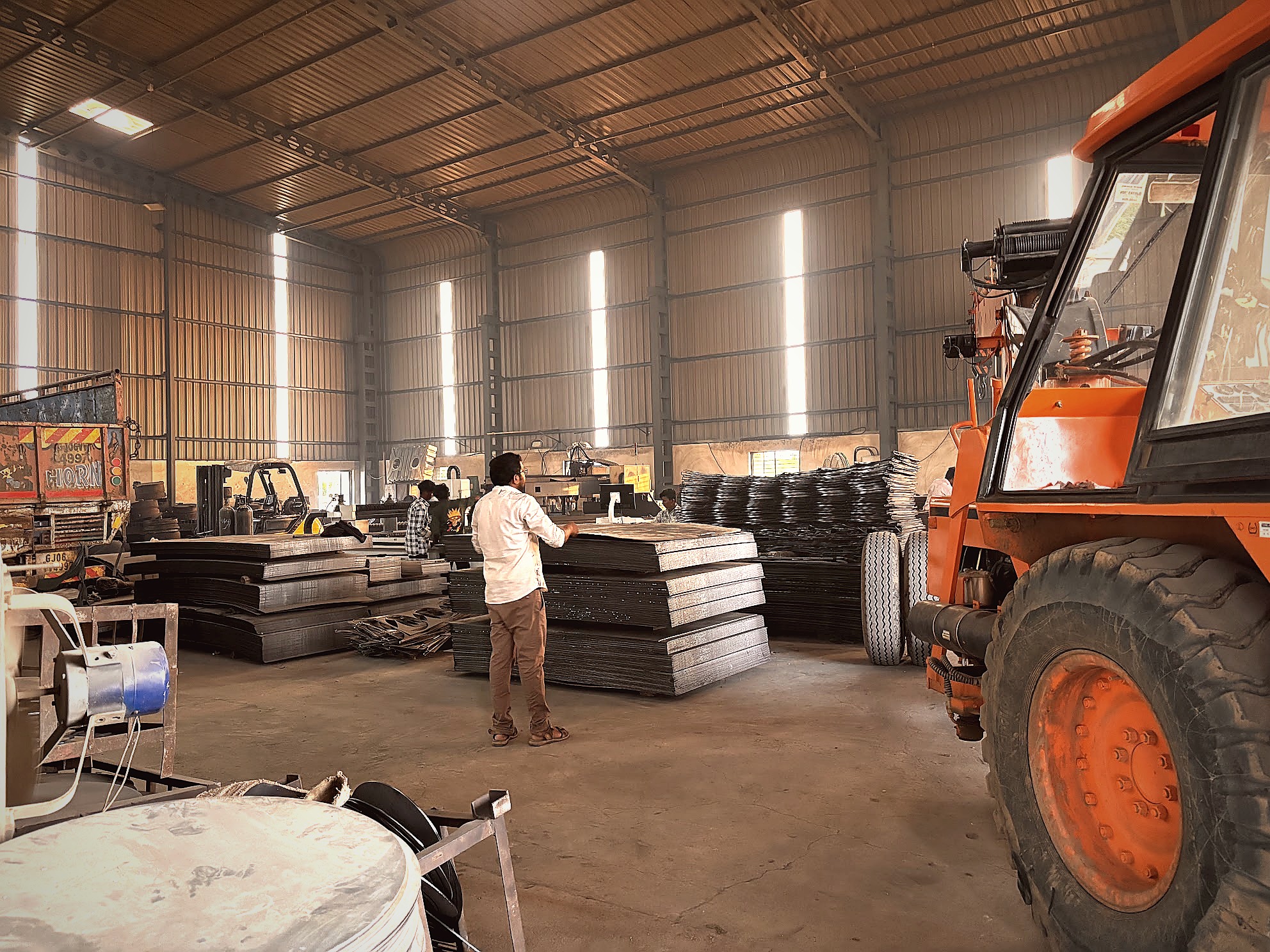
We've been manufacturing with 28MnCrB5 exclusively since we rebuilt the business in 2016. Every coil that enters our factory comes with a mill test certificate confirming the chemical composition. We source from SAIL, Jindal, TATA, and ArcelorMittal — mills that can supply consistent chemistry batch to batch. The consistency is as important as the grade: a disc blade is only as good as the heat of steel it was cut from.
What to ask your supplier
If you're currently sourcing disc blades and want to verify what you're actually getting, ask for the following:
Mill test certificate (MTC) — the certificate from the steel mill confirming chemical composition of the specific coil or plate used for your order. A supplier who can't provide this is buying steel without full traceability.
Hardness test report — Rockwell hardness readings (HRC) from actual samples of your production run, not a spec sheet. Ask for the reading location: surface hardness and mid-section hardness can differ significantly with lesser steels.
Steel grade designation — not just "boron steel" or "alloy steel" but the specific designation: 28MnCrB5, 30MnB5, B27, or equivalent. Each has a different composition and hardenability profile.
"Ask for the mill test certificate, not the spec sheet. The MTC tells you what steel was actually used. The spec sheet tells you what the supplier wants you to believe."
The process that makes the material matter
Steel grade is necessary but not sufficient. The reason 28MnCrB5 delivers its potential in our discs is the process behind it: CNC laser cutting for precise geometry, a gas-fired 8-zone conveyor furnace for controlled austenitisation, and simultaneous press quenching — where the disc is pressed to its final concavity profile and water-quenched in the same die operation.
Press quenching is what separates a disc that stays flat from one that warps during quench. The die constrains the disc throughout the cooling cycle, locking in both the hardness and the geometry simultaneously. No post-quench straightening, no residual stress from correction forces, no hidden variation in flatness. It's why our blades run true at high RPM in planter and seeder applications where imbalance causes premature bearing failure.
The fully automated conveyor line — furnace to press quench to shot blast — also removes the operator variable. Every disc gets the same thermal cycle, the same die pressure, the same cooling rate. The consistency you see in a batch of our blades isn't accidental: it's what happens when you remove the human hand from the critical part of the process.
The bottom line
If you're buying disc blades on price and your current supplier can't tell you the steel grade, provide a mill certificate, or show you a hardness test from your production run — you're accepting risk you probably haven't priced in. The extra cost per piece of 28MnCrB5 over 65Mn is real. The cost of replacing a full set of discs a season early, or losing a day of tillage to a cracked blade, is larger.
We're happy to supply samples, mill certificates, and hardness test reports on request. If you're evaluating disc blade suppliers and want to compare properly, that's the standard we hold ourselves to — and it's the standard we think you should hold everyone to.