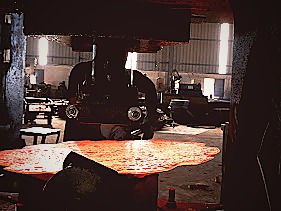
When a steel disc is heated to austenitisation temperature — typically 850–950°C for 28MnCrB5 — and then cooled rapidly, the steel transforms from austenite to martensite. Martensite is the hard microstructure you want. The faster and more uniform the cooling, the more complete the transformation, and the higher the resulting hardness.
The problem is that rapid cooling is inherently uneven. The outer surface of the disc cools faster than the centre. Different parts of the disc — the edge, the centre hole, the body — cool at different rates because they have different masses and surface-area-to-volume ratios. This uneven cooling creates internal stresses, and those stresses cause the disc to distort. In a conventional quench — where the disc is simply dropped into an oil or water bath — distortion is unavoidable.
Press quenching solves this by constraining the disc in a precision die throughout the entire cooling cycle.
How press quenching works
Press quench vs conventional quench — what actually differs
Disc exits the furnace and is dropped or lowered into an oil or water bath. Cooling is uncontrolled — different parts of the disc cool at different rates. The resulting thermal stresses cause warping and distortion. Discs must be straightened after quenching, either manually or in a press. Straightening introduces its own stresses and is never perfectly consistent. Flatness variation of ±1–2mm across the disc face is common.
Disc exits the furnace and enters the die within seconds. Cooling is controlled from both faces simultaneously by water flowing through the die. The die constrains the disc geometry throughout the cooling cycle — the disc physically cannot warp because the die won't allow it. Flatness of ±0.3mm or better is achievable. No straightening required. No additional stress from correction operations.
"In a conventional quench, you're hoping the disc comes out flat. In a press quench, the die guarantees it — because the disc cools inside the shape you've defined."
Why flatness matters more than most buyers realise
A disc blade that is slightly dished, cupped, or warped — even by a millimetre or two — doesn't run true. In a disc harrow or tillage implement, this causes vibration, uneven soil engagement, and accelerated bearing wear. In a high-speed planter or superseeder running at 500–800 RPM, it causes significant vibration and can damage the hub assembly within a single season.
OEM equipment manufacturers — John Deere, Lemken, Horsch — specify tight flatness tolerances on their disc blade drawings precisely because they understand what a warped disc does to their machines. Their suppliers are held to those tolerances. After-market suppliers often aren't, and buyers often don't check.
Press quenching is the only reliable way to hold tight flatness tolerances through the heat treatment process. Any other approach requires post-quench correction, and correction is always imprecise.
Why most manufacturers don't press quench
The honest answer is capital cost and complexity. A press quench setup requires:
Precision tooling — the upper and lower die must be machined to the exact concavity and diameter of the disc. Each size and profile requires its own die set. A manufacturer running 50 disc specifications needs 50 die sets. The tooling investment is significant.
A conveyor furnace — press quenching only works if the disc can be transferred from the furnace to the die instantly. This requires a continuous conveyor furnace, not a batch furnace. Batch furnaces are cheaper and more common; conveyor furnaces require a larger upfront investment but enable the automated, consistent throughput that press quenching demands.
Process integration — the furnace, conveyor, and press must work as a single automated system. The timing between furnace exit and die entry must be controlled precisely. This requires engineering, controls, and operational discipline that smaller manufacturers typically can't justify.
The result is that most Indian disc blade manufacturers use batch furnaces and tank quenching, then straighten the discs manually. The discs may achieve acceptable surface hardness, but the flatness, the consistency, and the through-section hardness are all inferior to what press quenching delivers.
We operate a gas-fired 8-zone conveyor furnace — 10 metres long, 16 burners — connected directly to a press quench line. The entire process from furnace entry to quenched disc is fully automated. No manual handling between furnace exit and quench entry. Every disc in a production run gets the same thermal cycle, the same die pressure, the same cooling rate. The consistency is mechanical, not operator-dependent.
What press quenching means for you as a buyer
If you're sourcing disc blades for OEM equipment or for resale to farmers running modern planters and superseeders, press quenching matters in three ways:
Fitment — a flat disc fits the hub assembly correctly. A warped disc may require forcing into position, which pre-loads the bearing and shortens its life.
Balance — a geometrically accurate disc runs true at high RPM. An out-of-flat disc causes vibration that the farmer feels as reduced planting accuracy and increased wear on the implement.
Consistency batch to batch — because our process is automated and controlled, the fifth disc in a batch is identical to the five-hundredth. Manual processes drift. Automated processes don't.
When you ask a disc blade supplier whether they press quench, the answer tells you something important about their process, their capital commitment to quality, and their understanding of what the disc actually needs to do in the field.
How to verify it
Ask your supplier for a flatness measurement report. A press-quenched disc should hold ±0.3–0.5mm flatness across the full disc face after heat treatment. If a supplier can't produce this report, or the numbers show ±1.5mm or more, the disc was not press quenched — it was straightened after the fact, and the straightening is hiding distortion, not eliminating it.
You can also check yourself with a straight edge and feeler gauge on a sample disc. Place the disc on a flat surface, press it down, and check the gap between the disc edge and the surface at multiple points. Any variation greater than 0.5mm on a disc that's supposed to be flat is a sign of post-quench straightening rather than true press quench flatness.